String Art on Paperchristmas Two Colors With 123 Howls
Howl's Moving Castle (ハウルの動く城 , Howl no Ugoku Shiro) is an animated fantasy movie directed by Hayao Miyazaki, produced by Toshio Suzuki and animated past Studio Ghibli. It premiered at the Venice International Film Festival on September 5, 2004, and premiered in Toho cinemas in Nippon on Nov xx, 2004.[1]
It is based on the 1986 novel of the same name (translated in Japan as The Sorcerer'due south Howl and the Devil of Fire) by British author Diana Wynne Jones and is near a young milliner named Sophie, who is transformed into an onetime woman by a witch, and the wizard Howl.
The first half of the film is relatively faithful to the original novel, but the 2d one-half was changed completely during development, adding themes of state of war not present in the source fabric. The original author, Diana Wynne Jones' just request was that Miyazaki "not modify Howl's character".[2] She subsequently gave a positive impression of the film, saying it retained the same spirit equally her original work.
Howl's Moving Castle had its world premiere at the Venice Film Festival on September 5, 2004, and was screened at the Tokyo International Pic Festival on October 23, 2004.[iii] It went on to gross ¥23.2 billion worldwide, making it one of the well-nigh financially successful Japanese films in history. The film received critical acclaim, particularly for its visuals and Miyazaki'south presentation of the themes. Information technology was nominated for an Academy Award for Best Blithe Feature at the 78th Academy Awards, but lost to Wallace & Gromit: The Expletive of the Were-Rabbit, in 2006, and won several other awards, including four Tokyo Anime Awards and a Nebula Award for All-time Script.
The film notably has Chieko Baisho, who voices Sophie, sing the theme vocal The Promise of the World, similar to Tokiko Kato who played Gina in Porco Rosso. The Ghibli Museum-exclusive animated short, The Twenty-four hours I Bought A Star, has ties to this film.
Contents
- one Plot
- ane.one A Chance Encounter
- i.two The Indelible Curse
- ane.iii Sophie's Choice
- 1.iii.one Confrontation with Suliman
- 1.four Honey of War
- 1.five The Boy Who Drank Stars
- 2 Characters
- three Mechanical Designs
- three.ane Moving Castle
- 3.2 Footing and Naval Transportation
- iii.3 Aviation
- 4 Motif
- iv.ane Changing One's Heart
- 4.ii The Symbol of Stars
- 4.3 The Happy Catastrophe
- v Backside the Scenes
- 5.i Pre-Production
- 5.2 Production
- 5.3 Dubbing
- 5.4 Sound Mixing
- 5.five Promotions
- 6 Release and Reception
- vii Ad Copy
- 8 Music
- 9 Easter Eggs & Trivia
- 10 Goofs
- 10.one The Magic Band
- 10.2 Cursed Habiliment
- 10.3 Escape from the Majestic Palace
- eleven Voice Cast
- 11.1 Additional Voices
- 12 Credits
- thirteen Related Products
- thirteen.1 Habitation Video
- 13.2 Publication
- 13.three Music
- 14 Media
- xv References
- sixteen External Links
- 17 Navigation
Plot
A Gamble Encounter
"Wow. He must have been a sorcerer then."
"But he was so kind to me. He rescued me, Lettie."
"Of course he did. He was trying to steal your heart! You lot are so lucky, Sophie. If that wizard were Howl, he would have eaten it."
"No, he wouldn't. Howl only does that to beautiful girls."
—Lettie and Sophie discussing her encounter with Howl

Sophie walking across the heaven with Howl.
Sophie, a needlewoman who works at her family unit'south hat shop, is a responsible-yet-plain 18-twelvemonth-old girl who goes to Cesari's café to visit her sister Lettie when she encounters by chance a mysterious wizard named Howl. This encounter arouses the evil Witch of the Waste product, who later enters the hat shop and transforms Sophie into a 90-year-old woman. Every bit the curse prevents her from telling anyone of her condition, Sophie decides to leave her home of Market Chipping and seek out a cure out in the waste.
The Indelible Curse
"You hope to help me if I aid you lot?"
"I don't know, lady. Demons don't make promises."
"Then go find someone else."
"Come on! You should feel sorry for me! That spell keeps me stuck in this castle, and Howl treats me like I'k his slave. It burns me up. You gotta keep the water hot, the rooms warm, keep the castle moving. If you can figure out how to break this affair I'1000 in with Howl, so you tin pause my spell. Afterwards that, I tin easily pause the spell that'southward on you."
"All correct, it's a deal."
—Sophie making a deal with Calcifer
Along the mode, Sophie meets upon the hill the scarecrow Turnip Head. She passes the mysterious moving castle and enters it. At this bespeak, she meets the enchanted fire demon named Calcifer, who powers the castle and recognizes that Sophie has been cursed. Calcifer offers to break the curse in commutation for Sophie's help in breaking the spell he's under, which keeps Calcifer jump to the house. She also meets Howl's young apprentice Markl.
When Howl appears, Sophie announces that she is the castle's new cleaning lady, hired by Calcifer considering he was sick of how dirty the castle was.
Sophie's Choice
"Howl, why is the Witch of the Waste matter trying to hunt yous down?"
"She was in one case quite beautiful, and then I decided to pursue her. And then I realized she wasn't. So as usual, I ran abroad. I tin't run much longer though. I accept to study to the palace as both Pendragon and Jenkins." "How many aliases practise you have anyway?"
"As many as I need to keep my freedom."
—Sophie asking Howl about Suliman
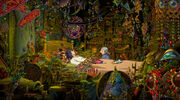
Howl hides in his room later being summoned by Madame Suliman. He sends Sophie in his stead.
Meanwhile, in Sophie'southward domicile country of Ingary, the showtime of a state of war has sparked against some other neighboring town - following the disappearance of the other realm's Crown Prince. Slowly the war begins to pitter-patter into Sophie's land itself. Howl receives summons from the King, who orders his various causeless identities to fight in the war. However, Howl cowers in his sleeping room and comes up with an idea to send Sophie to pose as his mother, announcing that he would exist useless. At the palace in the capital letter of Kingsbury, Sophie runs into an asthmatic dog, Heen, who she thinks is Howl secret. She as well meets the Witch of the Waste, who rides on a palanquin carried past two blob men. Magical wards atomize the Witch's henchmen and she is forced to travel by foot. They begin to race upwardly the stairs.
Confrontation with Suliman
"What on earth happened to you?"
"I merely restored her to the age she actually is. All her powers are gone now. Once, she, too, was a magnificent sorcerer with then much promise. But and so she fell prey to a demon of greed who slowly consumed her, trunk and soul. Our kingdom can no longer afford to turn a blind eye to these disreputable witches and wizards. If Howl reports to me and vows to employ his magic to serve the kingdom, I will show him how to break from his demon. If not, I'll strip him of all his powers. Only like her."
—Sophie request Suliman about the Witch of the Waste material and Howl's fate
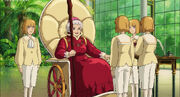
Madame Suliman and her servant Kosho and his siblings, who look suspiciously similar Howl.
Once they are within the castle, Heen and Suliman'southward servant Kosho atomic number 82 Sophie to the greenhouse while the Witch of The Waste finds herself a identify to sit downward - only to find her magical powers drained past Suliman as a punishment. This causes her to regress into a harmless sometime woman with few memories of her past actions. Suliman tells Sophie that Howl will meet the same fate if he does non contribute to the war. Equally Sophie vehemently protests these measures, the Witch'south spell temporarily weakens due to the love in her words. This causes Sophie to alter briefly to her younger self, so regress to her older persona. Madame Suliman realizes Sophie's true relation to Howl and her romantic feelings towards him. Howl then arrives to rescue Sophie, Suliman tries to entrap Howl past summoning star children and revealing his monstrous form, only with Sophie'south help, they escape. Howl suggests cartoon their pursuers abroad as Sophie make her way dorsum to the castle. He offers her a magic ring which would help guide her back safely.
Love of War
"Howl? Howl, is that you lot? Are you in pain? Tell me what's happening."
"Go abroad."
"No, I'grand non going away. I'thou going to assistance yous break the spell that you lot're under."
"You... You can't fifty-fifty break your own spell."
"Simply you lot don't understand. I beloved you."
"Y'all're as well belatedly."
"Howl! No!"
—Sophie confronting Howl in his dream

Howl and his makeshift family unit.
Sophie learns that Howl is able to transform into a bird-like beast to interfere in the war, just each transformation makes information technology more than difficult for him to return to homo form. Howl, in an attempt to gratify Sophie, transforms a office of the castle'southward into her old home by the hat shop, and even shows her a hush-hush garden he used to stay in his childhood. Sophie fears that Howl is preparing to leave them, equally his remaining fourth dimension as a human is limited, and he returns to interfering in the war. Sophie'southward female parent Honey shows up under Suliman'southward control and leaves behind a bag containing a "peeping bug" nether her orders. The sometime Witch of the Waste discovers it and promptly destroys the bug by tossing it into Calcifer who gets ill, rendering him unable to muffle the castle.
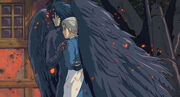
Howl leads Sophie to condom subsequently their dwelling house is bombed.
A few hours later, the city is carpet-bombed by enemy aircraft while Suliman's Blob men invade the hat store. Afterward arriving just in time to protect the store from the bombing, Howl draws the guards away after healing Calcifer. He tells Sophie he is non going to run abroad anymore because he has something he wants to protect before leaving to interfere with the war. Deducing that Howl must be saved, Sophie moves everyone out of the castle and removes Calcifer from the fireplace, destroying the castle. She offers Calcifer some of her braided hair to requite him plenty forcefulness to ability a portion of the castle. They head toward Howl when the one-time Witch of the Waste matter discovers Howl's eye within Calcifer. Sophie pours h2o on Calcifer to make her allow get of the heart, making Calcifer lose his power. The segment of the castle splits, and she and Heen fall downwardly a chasm.
The Boy Who Drank Stars
"I feel terrible, like there'southward a weight on my chest."
"A heart'due south a heavy brunt."
"Wow! Sophie, your pilus looks just like starlight."
"It's beautiful."
—Howl waking up upon seeing Sophie
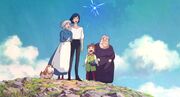
The war is over, and Calcifer returns to his friends.
Using her magic ring, Sophie makes her way toward Howl'south center, and enters through the door into Howl'southward childhood. She stumbles into his erstwhile cottage and looks upon his sometime things. Exterior the marshlands, she sees dozens of falling stars vanish as they land on the earth. She then sees Howl and Calcifer meet: Howl eats Calcifer, who gains his middle. Sophie finds Howl, having now lost his human consciousness in bird form. They head back to the group, and Sophie asks the Witch for Howl'due south center. She gives it to her and places the middle dorsum in Howl, resurrecting him and freeing Calcifer. She kisses the scarecrow who reveals that he is actually the missing prince. Heen shows the scene of their happy end to Suliman, and the war is finally over. Howl, Sophie, and the others render home from the end of the war, flight high in a higher place the bomber planes in a moving house.
Characters
- Howl (ハウル , Hauru)
- Takuya Kimura (Japanese), Christian Bale (English)
- The protagonist of this tale. A pretty boyfriend, Howl was rumored to eat the hearts of cute women. He travels throughout the land of Ingary via a magical moving castle. According to Suliman, he was a talented wizard who would've succeeded her in courtroom, simply Howl abruptly left due to his immaturity and cowardly nature. He hid himself and went under diverse pseudonyms such as Jenkins and Pendragon. He lived a somewhat wretched life away from club, but grew to be more than humane thank you to Sophie. Howl came under contract with the burn demon Calcifer in his youth, which further increased his magical powers. However, his constant use of demonic powers proved to be dangerous, and Suliman would later on warn him that he may become a demon himself. Howl happens to have a long deceased uncle who left a hidden flower garden on his study in his old cottage.
- Although Howl began as a blonde, he barbarous into a deep low upon seeing Sophie's cleaning which dissolved some of his magic, turning his hair black. He eventually recovered, and kept his new black hair. Whenever Howl flies to the battleground, he transforms into a huge blackness swallow that possesses his human face.
- Sophie Hatter (ソフィー・ハッター, Sofī Hattā)
- Chieko Baisho (Japanese), Emily Mortimer (young), Jean Simmons (old) (English)
- Some other protagonist of this tale. The eldest daughter of three sisters. She'due south eighteen years quondam and works equally a needlewoman at her family'due south store, the "Hatter's Hat Shop", which was originally managed by her father.
- She is transformed into a ninety-year-old old adult female by the expletive of the Witch of the Waste product and would later become the cleaning lady of Howl aboard his moving castle. She develops romantic feelings for Howl, who himself develops into a positive and assuming character.
- Unlike her prettier and more pop sis Lettie she appears plain and more than subservient. After turning into an old woman, she slowly gains conviction in herself. She originally possesses dark-brown hair, but afterwards being cursed, her hair becomes "stained by the light of the star" according to Howl. Sophie herself does not notice her age changes depending on her emotional state.
- In the original Japanese version, Sophie is played solely past Chieko Baisho. In the English, French and Spanish dubbed versions, the voice actors for her role were cast separately.
- Witch of the Waste (荒地の魔女, Arechi no Majo)
- Akihiro Miwa (Japanese), Lauren Bacall (English)
- A witch who had been exiled from the royal palace to the wastelands after making a contract with a demon fifty years before the events of the film began. She dresses in opulent jewelry and black fur and carries herself much like a wealthy adult female. She moves around using a palanquin due to her corpulent figure and aversion to sunlight.
- Her singular goal is to accept Howl'due south centre. She is also obsessed with youth and dazzler and boasts strong magical powers. She holds a grudge against Suliman who exiled her from the royal palace. Her magical powers are taken away from a ability exposure to light, and her true course is revealed to be a senile old woman.
- Calcifer (カルシファー , Karushifā)
- Tatsuya Gashuin (Japanese), Baton Crystal (English)
- The fire demon who signed a contract with Howl. He received his center and in return, gave the immature wizard incredible magical powers. He also bound himself to a magical moving castle. Additionally according to their contract, Calcifer's life is direct linked to Howl's. Calcifer plots with Sophie to find a manner to break their pact and then he could exist free. Even so, he feared Howl was abusing his new demonic-fueled ability and hoped breaking their contract would save him from further corruption.
- Calcifer's graphic symbol inappreciably differs from the original novel, although in the original cover, he is lit in a blueish flame.
- Markl (マルクル , Marukuru)
- Ryūnosuke Kamiki (Japanese), Josh Hutcherson (English language)
- Howl's disciple. A young boy that appears to be around 8-ten years old. He wears a magical cloak which disguises him equally a petite old man a long mustache whenever he goes out or deals with customers. He refers to Howl with the "san" honorific whenever they converse. When he starting time meets Sophie, he behaves like an adult, but gradually shows his childish nature. He hates potatoes and fish.
- He was originally a 15-twelvemonth-old boy named Michael in the novel.
- Turnip Caput (Prince Justin) (カブ , Kabu)
- Yō Ōizumi (Japanese), Crispin Freeman (English)
- A scarecrow with turnip every bit a head . He is saved past Sophie later on his caput gets caught in a bush-league in the outskirts of the wastelands, and he later becomes a resident of a moving castle. He cannot speak, merely gets along by hopping around. Sophie kisses him, revealing his true class to be a beautiful prince of the neighboring state. He explains he was turned into a scarecrow, possibly by Suliman. He promises peace between the two warring kingdoms, and hops away on his magical stick, possibly indicating he is a wizard.
- Hayao Miyazaki initially rejected the idea of the curse beingness lifted, but was eventually convinced by Ghibli video checking staff Hitomi Tateno.
- Suliman (サリマン , Sariman)
- Haruko Kato (Japanese), Blythe Danner (English language)
- Howl'south old master, as well known every bit Madame Suliman. She'southward an former, silver-haired witch on a wheelchair who heads the kingdom's magic academy and serves the royal family'due south court. An intelligent and seemingly gentle woman, who possesses far greater magical ability than Howl. She's the true power backside the kingdom of Ingary, and was never completely in favor of the war. Every bit information technology becomes clearer towards the finale of the film that their kingdom was being bombed into ruin, she decides to cease the state of war upon contacting her agent, Heen.
- The purple sorcerer in the original story is a completely dissimilar character named Ben Sullivan.
- Heen (ヒン , Hin)
- Daijiro Harada (Japanese)
- Suliman's familiar, nether the guise of a family unit domestic dog. He'due south asked to meet Howl on the courtyard and afterwards forces Sophie to take him beyond a long flight of stairs. His unusual weight implies he may exist a sorcerer in disguise. His legs closely resemble a bird's. He later appears before Suliman to report that Howl and Sophie had a "happy ending".
- Heen'due south model is maybe based on Hayao Miyazaki'southward old acquaintance, the manager Mamoru Oshii.
Mechanical Designs
Moving Castle

Howl's castle, traveling across the wastelands.
Magician Howl's home. It's scale changes from scene to scene, and its weight is unknown. There are multiple turrets on the top and turret-similar structures in the front, but film gives no indications that they burn. It moves effectually the wasteland with four bird-like legs. To the naked heart, information technology appears more like a drove of junk and a living creature than a traditional "castle".
Few know the precise location of the castle, but eyewitnesses claim to have seen information technology laissez passer by several towns from time to time.
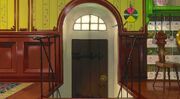
The castle's main doorway and its magical rotary switch.
In that location is a rotary switch continued to the chief doorway, with 4 colors (green, blueish, red, black). Using the switch and entering the doorway will ship you to either the wastelands (green), Porthaven (blue), Kingsbury (red), and a battleground (blackness). Later in the film, the order of destinations is changed to green, yellowish, pink, black, with yellow becoming the town where Sophie was built-in and pink condign Howl's hush-hush garden.
The fire demon Calcifer supplies all the energy to the castle, which supports its basic functions such every bit walking, lighting, cooking and bathing.
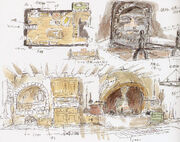
Concept sketches of the living room, along with Calcifer's chimney.
Calcifer'south magic too holds the castle's structure together. If he so happens to leave of the castle, the entire construct would collapse in an instant. Towards the end of the motion-picture show, the castle collapses due to Sophie and the Witch of the Waste matter dousing Calcifer with water. The castle is somewhen rebuilt into a flying monstrosity.
The castle'south blitheness was inspired by a weaving auto in move, and moved along with a heavy, creaking sound. Staff at Studio Ghibli were of the opinion that that information technology would be unpleasant to use metallic sounds while information technology was in motility, so they opted to utilize the squeaking sound of wood to express the castle's weight. They chosen on a local carpenter to the studio, assembled the building materials, and kneaded and captured various sounds that were rubbed, moved, and cleaved. The castle's sound design and movement was finalized in 3 to four months.
Much of the flick's country and naval transportation uses steam engines. In humming towns, steam cars, steam tractors and steam trams tin be seen, which wasn't the instance in reality as the use of diesel engines took over. Naval battleships were used during the war, with one fleet seen leaving the harbor city of Porthaven.
A steam locomotive tin can also be seen in the opening of the film that travels under Sophie'due south domicile.
Aviation

Fixed wing bombers from the rival kingdom.
Much of the flapping-type flying machines widely used throughout the film were inspired past 19th century French artist Alberta Robida's work. Several types of these flapping-type warships operated in both kingdoms and its neighboring territories. Large aerial bombers are used in fleet combat and are seen bombing cities as well. Neighboring countries also operated massive fixed-wing bombers. The propulsion for these warships, such as the flying battleship is mainly covered by pocket-sized moving wings fixed on the ship's hull, while propeller engines are inappreciably used. Many of the massive airships seen are besides mainly used for armed forces and not noncombatant utilize.
A small-scale, two-seater "flight kayak", besides makes appearance. They are mainly used by the military, although ordinary people are seen giving it a test-ride outside the palace's archway in Kingsbury.
Motif
Changing One's Heart
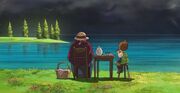
Sophie finds peace in old age.
According to French fansite Buta Connexion, the motion picture'south bulletin, "backside an apparent simplicity, is much more circuitous than it appears. From a simple approach to old historic period, we can then read several levels of reflection around appearances, pretenses and masks. In fact, Sophie is the allegorical character of this theme. She initially appears in a youthful guise, just her stepmother Love calls her far too serious for a immature girl."
"After the initial shock of her metamorphosis by the Witch of the Waste, she gets used to her new body very quickly, despite her face being hollowed out with wrinkles. This curse is therefore more a burden, and gradually, Sophie adopts this tired body and deals with it pretty well, as seen in the scene with her and Markl by Star Lake, since information technology corresponds to his state of listen: "I don't remember I have never known such peace."
"But sometimes, at key moments, Sophie lifts the spell and becomes a beautiful young girl again. When she passionately defends the immature wizard, when she confesses her love to him in her dreams, or when she sleeps, others can see her in her juvenile form. Merely the slightest doubt, the slightest fear brings her back to her old woman's trunk: she confides to Howl. As she explains in a fit of acrimony, she feels ugly, and one can think that her appearance of an quondam adult female thus comforts her in her vision. By accepting her beauty, her dear for Hauru, she volition pause the spell and can finally go this beautiful immature girl with whom Howl is in love.'
The Symbol of Stars
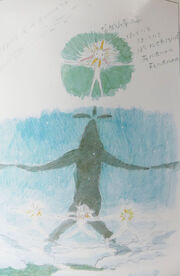
Concept sketch of the star children.
According to French fansite Buta Connection, "throughout the flick, Miyazaki also leaves a mutual thread: the star. They appears early on in the film, when Sophie arrives in the castle. She gives Howl a small slice of newspaper which turns out to be a curse. Nosotros realize that it is a falling star. Later, Suliman volition endeavor to trap Howl by casting a spell on him, which takes the class of a circular of shooting stars encircling the magician and Sophie. Then, our heroine volition notice the key to this riddle: Calcifer was a demon in the form of a meteor, with whom Howl will make a pact. This discovery volition forever marking Sophie, whose hair will remain greyness, like the color of the star, as if the discovery of the enigma were to mark her forever."
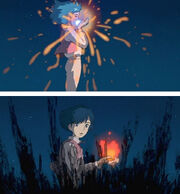
Howl makes a pact with Calcifer, a demon in the form of a star.
"We sympathize and then that the Witch of the Waste matter has always known Howl'southward curse too, hence her message and her involvement in Calcifer. This symbolism of the star is one of the recurring themes of the story's universe: the iii wise men and the polar star, the myth of Castor and Pollux turning into a star, The Trivial Prince. But in Howl's Moving Castle , Miyazaki in one case once again reverses the symbolism. Where usually the star evoked hope, the fulfillment of a wish, the miracle, the star here becomes a curse, a powerful spell which pursues Howl throughout the work, and which will marker Sophie forever."
The Happy Catastrophe
Co-ordinate to Buta Connectedness, "the about hit fact of the picture show remains this strange, abrupt happy ending, this semblance of "they married and lived happily ever after"! This is the first time Miyazaki has fully causeless a romantic human relationship between the lead characters. But it's besides probably the but time its catastrophe seems so idyllic, stereotypical and definitive. Usually we know that, with an open up ending, Miyazaki leaves it up to the spectator to imagine whatsoever follow-up to his adventure. Only looking more closely at the end of Howl'southward Moving Castle, we can look at a few elements that tin can qualify this bespeak of view."

The film's idyllic and definitive happy ending, uncommon to run into in a moving picture by Hayao Miyazaki.
"Get-go of all, Suliman's disconcerting mental attitude seems to ship usa a message: this terrible war is in fact only a simple battle of ego of sorcerers who play with their subjects similar vulgar pawns. Suliman getting tired of this game, she decides to cease this apocalyptic war like a child stopping his game of Monopoly. The message is therefore much stronger than the credible casualness with which Miyazaki seems to treat the subject."
Then that concluding buss and that idyllic vision of the picayune family aboard Howl'south flying castle may confuse viewers. Such an piece of cake and predictable happy ending is uncommon for the veteran director. However, equally the credits gyre, the terminal song gives some insight to the managing director'south intent:
[...] Even at present alone,
I call up our yesterday together,
Today even so shines brightly
From the twenty-four hours we met
In my memories, you don't belong anywhere
Come as a gentle breeze to graze my cheek
Even afterward our separation,
At a fourth dimension when the sun was disappearing in the trees
The promise of the world is not cleaved at all
Even now alone,
My tomorrows are endless
Because, y'all taught me, sweet hides in the night [...]
"The outcome with the idyllic bulletin is tinted with a new and foreign nostalgia: What future then for our characters? Volition an event separate Howl and Sophie? Would their honey exist threatened?"
Backside the Scenes
Pre-Production
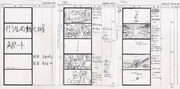
Rejected storyboards by Mamoru Hosoda which may take possible set the moving-picture show in the modernistic era.
Every month, publisher Tokuma Shoten sent Hayao Miyazaki a children's volume every month. One of those books happened to be Diana Wynne Jones' original novel, which intrigued Miyazaki, who then decided to adapt it into a feature-length blithe film.[iv]
In 2000, animator Mamoru Hosoda, who worked at Toei Blitheness at that time, decided to become a director and was invited past Studio Ghibli to adapt the novel. Howl's Moving Castle would have been Hosoda's debut equally a managing director, and he was given Miyazaki's approval, equally the elder director had grown to love the young talent'due south piece of work. A production squad was formed, which included screenwriter Reiko Yoshida and animation managing director Katsuya Kondō.
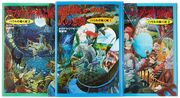
Howl's Moving Castle Tankobon Hardcover edition. The first volume was published by Tokuma Shoten on May one, 1997.[v]
Studio Ghibli originally planned to release Howl'due south Moving Castle simultaneously with The Cat Returns (2002), which was tentatively chosen Baron at that time. In April 2001, the beginning typhoon for the scenario was completed, and on Dec 13th of the same twelvemonth, Toho announced that the film would be released in the bound of 2003.[6] Early on concept work by Hosoda showed that the motion picture would have taken place in modern times.
Yet, in spring of 2002, the project was abandoned and Hosoda, along with his production staff, parted means with Studio Ghibli. The internal staff at Ghibli were initially confused as to why product had ceased, and Hosoda later on cited he was sacked by the legendary studio. Ghibli producer Toshio Suzuki never gave a clear reply as to his difference.
Production
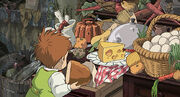
The film featured exquisitely drawn food, a staple in Studio Ghibli films.
On October 1, 2002, production restarted, this fourth dimension with Hayao Miyazaki equally the director.[seven] Hosoda was shocked and upset by these turn of events, but later recalled, "I think I was too young at the time". It had been rumored that Hosoda's version of "Howl'due south Moving Castle" was kept somewhere at Ghibli, but Hosoda remained vague when interviewed regarding this.
On December 13, 2002, Toho announced that Howl's Moving Castle would be released in the summer of 2004.[viii] Storyboard cartoon began on February 1, 2003, and product was scheduled to be completed in the spring of 2004.
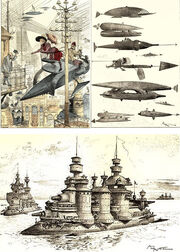
French illustrator and novelist Albert Robida's work is a abiding source of inspiration for Hayao Miyazaki.
Under the advice of the Walt Disney French distributor of Spirited Away, Miyazaki discovered the boondocks of Colmar, in Alsace, France, and was struck past its architecture.[ix]. During the trip, the squad notably visited the Haut-Kœnigsbourg castle and observed the piece of work of local craftsmen such every bit hats and blacksmiths. Diana Wynne Jones approved of the choice of such an aesthetic bias, "I've never been to Alsace, but I've heard that there are landscapes direct out of a fairy tale."
To dilate this French atmosphere, Miyazaki took inspiration from French illustrator and novelist Albert Robida (1848-1926). This rival of Jules Verne projected his visions of the future through novels such as The Twentieth Century, where zany romanticism and technical rigor are mixed, which also figure in Miyazaki's films.
Howl'southward titular castle, which was barely described in the original novel, was conceptualized by Miyazaki as being fabricated entirely of chip iron, walkways, and has a gaping mouth spewing steam. The design is reminiscent of the creations of Jean Tinguely, a 20th-century Swiss sculptor artist.

Howl's castle is broken down into several components to exist pieced together for final animation.
This technical challenge in animating the castle was be taken upward by the team of graphic designers. The painted design is first scanned on a computer before it is broken down into several components and then pieced back together like a mosaic using Adobe Photoshop. The drawing volition therefore exist divided into a multitude of small fragments: the smaller the pieces, the more than precise the rendering of the texture set in motility.
Finally, with the Softimage software, the parts are assembled on a base polygon, paying careful attention to their guild of superposition. Once the elements are in place, it is animated as a whole. In guild to brand the movement of the castle as realistic equally possible, the graphic designers took inspiration from a full hiker bag with hanging utensils. The base of operations polygon of the castle must brand the superimposed elements movement slightly offset. The castle then appeared asymmetrical, where Westerners are more accepted to symmetrically designed buildings.
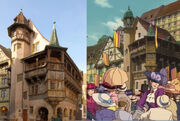
Miyazaki, Steve Alpert, and several others traveled to Colmar in Alsace, French republic for location research.
Equally for the legs, several versions were made, such every bit human legs only the last design used bird's legs. Another question arose, how many legs would the castle have? The crew settled for four, as according to producer Toshio Suzuki, it was 'more practical (and cheaper) to draw'.
On January vii, 2004, Toho suddenly announced they were delaying the picture's release due to Miyazaki non completing the film's storyboards and even increasing the film'due south length. This was the first time for Miyazaki decided to postpone the release of his films due to production delays. On June 25, the in-betwixt blitheness was completed and checking was completed on June 26. Toho announced the film would exist released on November 20, 2004.
In Feb 2004, a sticker-collecting advertizement campaign was held past convenience store chain Lawson, with a special mug as a prize. Heen the dog appeared on this special prize, known every bit Innocence Howl's Moving Castle Mug Present.[10] A like promotional campaign would also exist utilized in after Ghibli films.
Dubbing
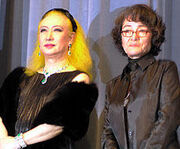
Akihiro Miwa and Chieko Baisho together during the film'south premiere.
Veteran actress Chieko Baisho voiced both the immature and old versions of Sophie in the moving picture when she was 63 years old. Baisho started out as a singer in 1962 and became well known for playing the role of Sakura in the long-running film series Otoko wa Tsurai yo, commonly known as Tora-San, which ran from 1969 to 1995. Takuya Kimura, a pop vocalist / male idol in Nippon, was responsible for voicing Howl. At the fourth dimension, Johnny & Assembly agency, the producers of Kimura, had immense force per unit area over the entire Japanese audiovisual landscape and imposed his casting on Miyazaki. Equally for the role of the Witch of the Waste, the player-vocalist-trans activist Akihiro Miwa was chosen since the character was conceived. Lastly, Ryûnosuke Kamiki was chosen for Markl and Tatsuya Gashûin was cast equally Calcifer. Both actors respectively played the babe Boh and the green frog in Spirited Away.
Ultimately, this desire to employ actors and singers — and oft well-known ones at that — over vocalisation actors in Ghibli films does appear to satisfy both the creative desires of Miyazaki as director and promotional needs of Suzuki equally producer.
In the interview, given to the Guardian in 2005 ahead of the U.K. premiere of Howl's Moving Castle, Miyazaki was commenting on the foreign actors bandage for the movie's dubbed version. When the discussion turned to Lauren Bacall, who voiced the Witch of the Waste for the English-language dub, Miyazaki spoke approvingly, describing her as a "a fabulous woman". He then went on to say, "All the Japanese female vocalization actors have voices that are very coquettish and wanting male attention, which was non what we wanted at all."[11]
Sound Mixing
In October 2003, after animation was completed, Studio Ghibli's sent a squad to Europe to record ambient sounds. Since the film took place in an imaginary 19th century, Miyazaki insisted on authentic and "pure" sounds. The team faced numerous challenges recording pristine sounds devoid of electric interference. In detail, they recorded the sounds of footsteps, then of equus caballus-drawn carriages on traditional cobbled roads besides as ambient sounds of cafes and streets in French republic.
Promotions
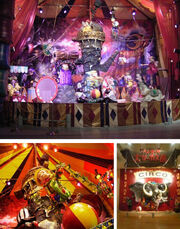
Howl's Moving Castle Big Circus Exhibition took identify from April 27 to Baronial 31, 2005, at the Museum of Contemporary Fine art Tokyo. It so moved to the Osaka Nanko ATC Museum from March eighteen to Apr 16, 2006.[12]
Several Howl related promotional events and exhibitions were held to commemorate the film. The first was the Howl's Moving Castle Grand Circus Exhibition that was held from April 27 to Baronial 31, 2005, at the Museum of Contemporary Fine art Tokyo.[13] The exhibit inside included a large mockup of a real life circus, with Howl'southward castle equally the centerpiece, while outside featured a big balloon playground of Howl'south castle and French street performers.[14] The entrance fee was 1,000 yen for adults, 800 yen for loftier-school students, and 500 yen for children. Tickets could exist purchased at whatsoever Lawson convenience shop, as they were a sponsor for the film.
On July 21, 2004, the popular department concatenation Nihombashi Mitsukoshi held a commemoration result called "Castle exhibition where Howl moves" at the seventh floor amusement hall. It featured a large-scale model of Howl's castle, and recreations of the "Lake of stars" and "World of Darkness" and many more. The showroom was held until Baronial one, 2004. The display was remarked on the Yomiuri Shimbun newspaper on July 16. Admissions for adults and university students cost 500 yen while junior high school children cost 300 yen. Many children were reportedly in omnipresence.[xv]

Photographs of the Howl display at Ginza Matsuzakaya.
Still another Howl'southward exhibit was held from December 23, 2004, to January 10, 2005, this time at Ginza Matsuzakaya department store. Several Howl related merchandise were sold at the showroom, although pictures were not allowed to be taken. A virtual event for the film was held on November 3, 2004, at the edifice of Nippon Goggle box Network Corporation in Shiodome. The opening ceremony was held at the large roof plaza. The model of Howl'southward castle from the Museum of Contemporary Art Tokyo exhibit was later on moved here for the special summer event called GO!Become! SHIODOME (July 17th to August 31th of 2004).
On the Baronial,16, 2004, Joe Hisaishi and the Yomiuri Nippon Symphony Orchestra performed several classic Ghibli themes, including those from the moving picture at Minatomirai hall in Yokohama City. The evening paper Yomiuri Shimbun covered the event on June 12, 2004.[16]
Release and Reception
→ See Howl'south Moving Castle/Release
→ Come across Wikipedia
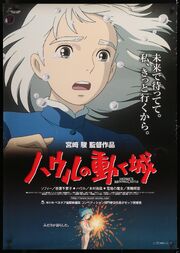
One of several release posters for the film.
After several loftier-profile paper announcements promoting the film'south success abroad at the Venice International Film Festival, not to mention the controversy surrounding the casting of Takuya Kimura, Toshio Suzuki successfully lobbied for the The moving-picture show to premiere on 450 screens beyond Nippon.[17] The film was a smash hit, selling nigh 1.1 million tickets on its second 24-hour interval of release. It generated ane.48 billion yen in the box office, which was the highest opening of any Japanese movie in history at that time. By May one, 2005, the picture show went on to sell 15 1000000 tickets or a box office revenue of 19.6 billion yen, making information technology the number one box office champion of 2004 and 2005. It is considered the second largest box role earner in Ghibli history afterwards Spirited Away. As of May 2007, nearly 2.7 million units were sold on home video.
The picture show received several accolades abroad, such every bit the Osella Laurels at the 61st Venice International Picture Festival and the Best Animation Award of the New York Film Critics Clan the following year. In addition to being nominated for the characteristic picture show section of the 33rd Annie Honour, which is said to exist the University Honor for Blitheness, it was besides nominated for the 78th Academy Laurels since Spirited Away. In 2008, it was voted among the best 500 movies in history by the Empire magazine. The film ranked at #46 in the British magazine's 2011 Full Movie "best animated moving-picture show" category.
Upon its kickoff TV circulate on July 21, 2006, information technology had a record loftier audience rating of 32.ix% (video research, Kanto surface area survey).

The decision to bandage Takuya Kimura due to pressure from his agency proved controversial at the time.
Acclaimed managing director Mamoru Oshii praised the film for cartoon out the nighttime side in Hayao Miyazaki for the first time. The story is an "unreasonable just mature expression." Despite its box office success, reviews were initially mixed in Japan as some critics disliked its illogical and clichéd plotting. Others faulted the film as existence Studio Ghibli's get-go "stumble" after a cord of critical successes. The pic also met some controversy in its casting of Takuya Kimura to play the titular Howl. Many critics have judged his performance beneath the quality expected for a Ghibli. Meanwhile, Miyazaki himself was dissatisfied with the moving picture'southward critical response locally and away, as audiences in Europe favored the Japanese setting of Princess Mononoke and Spirited Away.
When Miyazaki announced his early retirement at the time, he was asked which was his favorite work thus far. He immediately replied, "I wouldn't say it'due south my favorite, but Howl'south Moving Castle is a thorn that has stuck in me for years."
Advertizement Re-create
The film'south various posters and advertizing featured short phrases, translated hither.
- "The ii lived." (Shigesato Itoi)
- "The castle moves."
- "The joy of living."
- "Loving joy."
- "The heroine is a 90-year-quondam girl."
- "My lover is a weakling wizard."
Music
Howl's Moving Castle (Prototype Album) (イメージ交響組曲ハウルの動く城 , Hauru no Ugoku Shiro Imeeji Arubamu) was a 10-runway album released by Tokuma Japan Communications on Jan 21, 2004. Information technology was composed by Joe Hisaishi and performed by the Czech Philharmonic Orchestra.
Howl'southward Moving Castle (OST) (サウンドトラック , Hauru no Ugoku Shiro) was released by Tokuma Japan Communications on November 19, 2004. The score was composed and conducted by Joe Hisaishi, and performed past the New Japan Combo.
Hisaishi stated he was influenced by famed composer Nino Rota'southward score for Francis Ford Coppola's The Godfather. Other influences could be traced to French director Marcel Albert Carné's work. The soundtrack CD was first released on November 19, 2004, by Tokuma Nihon Communications. Hisaishi besides composed and conducted a special "Epitome Album" called Howl's Moving Castle: Symphony Suite, which was published on January 21, 2004.
Easter Eggs & Trivia
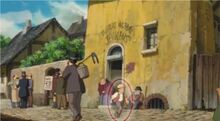
- As elder Sophie leaves Howl'south shop, a boy pass the store. He looks similar Pazu from Castle in the Sky. He is seen again in Market Chipping, when Sophie leaves her home town. He sits side by side to a man on a cart with straw on it.
- 1 of the boxes in the bakery is dated "1877", implying the film takes identify in the tardily-19th century.
- Miyazaki original wanted to telephone call the moving-picture show "Howl's Ugoku Castle", simply this was "forcibly" rejected by producer Toshio Suzuki.
- Mamoru Hosoda was originally supposed to direct the film, but dropped out due to creative differences.
- Upon seeing Spirited Away, Christian Bale immediately agreed to play any role in this film. He didn't expect to get the titular role.
- Hayao Miyazaki and Lauren Bacall, both long-time fans of each other's work, met at a subtitled screening in New York. Reportedly, Bacall jokingly asked Miyazaki if he was married.
- Sophie'southward hometown was modeled afterwards Colmar, France, although many signs are in German. This may exist due to how the setting of the picture is somewhere in-between the borders of France and Germany.
- Although the movie was not released in the United Kingdom until 23 September 2005, manager Hayao Miyazaki personally traveled to England in the summer of 2004 to give a private showing of the motion-picture show to Diana Wynne Jones.
- In the novel by Diane Wynne Jones, Markl's graphic symbol is actually named Michael.
- Before long after the film'due south release, information technology was subject to a short 2005 documentary, Ghibli: The Miyazaki Temple.
- The film's second one-half was changed somewhat due to Miyazaki's opposition to the United States' invasion of Iraq in 2003.
- At the end of the movie, the words "Happy Cease" appear.
- A small replica of Howl's castle was congenital in Asahikawa, Hokkaido.
Goofs
In the world of wizards and witches, everything is possible. Maybe the goofs were added on purpose.
The Magic Ring

When Sophie and Howl abscond from Blobbmen for the first time in the flick, they fly to Chezarys where Lettie works. Howl's rings vanished and appeared again. It happens two times during the fly.
Cursed Vesture
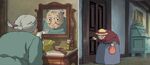
The Witch of the Waste product cursed Sophie who becomes an old lady. Her body shape and size changed. So her clothes from her immature historic period wouldn't fit her, merely she elects to clothing the same clothes. It was shown visually in Porthaven Marshes where Howl shows Sophie his secret garden.
Escape from the Royal Palace
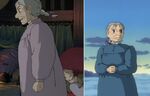
When Sophie and her companions escape from the palace and finally reach Howl's Castle, Sophie wears lilac/purple/lavender/mauve/rose/pink/rosy clothes. In the next scene, the colour changes into blue.
Vocalism Cast
| Graphic symbol | Original | English language |
|---|---|---|
| Sophie | Chieko Baisho | Emily Mortimer (young) Jean Simmons (old) |
| Howl | Takuya Kimura | Christian Bale |
| Witch of the Waste | Akihiro Miwa | Lauren Bacall |
| Calcifer | Tatsuya Gashuin | Billy Crystal |
| Markl | Ryūnosuke Kamiki | Josh Hutcherson |
| Suliman | Haruko Katō | Blythe Danner |
| Lettie Hatter | Yayoi Kazuki | Jena Malone |
| Beloved | Mayuno Yasokawa | Mari Devon |
| Turnip Caput/Prince Justin | Yo Oizumi | Crispin Freeman |
| Madge | Rio Kanno | Liliana Mumy |
| King of Ingary | Akio Otsuka | Mark Silverman |
| Heen | Daijirō Harada | |
Additional Voices
- Original: Manabu Muraji, Ken Yasuda (Soldier)
- English language: Carlos Alazraqui, Newell Alexander, Rosemary Alexander, Julia Barnett, Susanne Blakeslee, Leslie Carrara, Mitch Carter, David Cowgill, Holly Dorff, Moosie Drier, Iake Eisenmann, Will Friedle, Bridget Hoffman, Richard Horvitz, Sherry Hursey, Promise Levy, Christina MacGregor, Joel McCrary, Edie Mirman, Pete Renaday, Kristen Rutherford, Warren Sroka
Credits
| Credit | Staff |
|---|---|
| Manager, Screenplay | Hayao Miyazaki |
| Animation Managing director | Akihiko Yamashita, Takeshi Inamura, Kitaro Kosaka |
| Cardinal Animation | Atsuko Tanaka, Ai Kagawa, Kenichi Yamada, Hideaki Yoshio, Eiji Yamamori, Kazuyoshi Onoda, Makiko Suzuki, Mariko Matsuo, Atsushi Tamura, Hiromasa Yonebayashi, Masashi Okumura, Masashi Yokota, Masaru Matsuse, Makiko Niki, Seiko Shinohara, Kondo. Katsuya, Sugino Sachiko, Yamakawa Hiroomi, Awada Tsutomu, Takeuchi Nobuyuki, Kimishima Shigeru, Masuda Hiroshi, Ohsugi Yoshihiro, Hashimoto Takashi, Masuda Toshihiko, Yazaki Kenji, Tanaka Yuichi, Hamasu Hideki, Ohira Shinya, Konishi Kenichi, Shigeta, Atsushi Yamada, Shinji Otsuka |
| In-Between Animation | Akihiko Adachi, Akiko Teshima, Akiko Toba, Akira Hosogaya, Alexandra Weihrauch, Atsuko Matsushita, Ayako Mori, Ayano Suzuki, Chikako Sasagawa, Daisuke Furuya, Daisuke Makino, Emiko Iwayanagi, Fumie Konno, Hideo Nakamura, Hiroaki Nakajima, Hiromi Nishikawa, Hiromi Sasaki, Hisako Yaji, Jinko Tsuji, Kaori Itou, Kaori Tokunaga, Katsutoshi Nakamura, Keiko Tomizawa, Keisuke Shimohira, Kimitoshi Ueno, Kiyoko Makita, Kumiko Ohta, Kumiko Tanihira, Kumiko Terada, Kunitoshi Ishii, Mai Nakazato, Makoto Oohara, Masakiyo Yamashita, Masako Sakano, Masako Sato, Masami Nakanishi, Masashi Karino, Masayuki Shimizu, Maya Fujimori, Mayumi Kitamura, Mayumi Ohmura, Minoru Ohashi, Mitsu Noguchi, Moyo Takahashi, Osamu Miwa, Rie Kondo, Rie Yamamoto, Saho Saito, Satoe Usui, Seiko Higashi, Setsuya Tanabe, Shinichiro Yamada, Shunsuke Hirota, Sumie Iwata, Sumie Nishido, Takahito Sugawara, Takefumi Hiramatsu, Tetsuaki Matsuda, Tomoko Miyata, Tsutomu Kaichi, Tsutomu Shibutani, Waka Hirota, Yasuyuki Kitazawa, Yayoi Toki, Yohei Nakano, Yoshie Hayashi, Yoshitake Iwakami, Yukari Umebayashi, Yukari Yamaura, Yukie Kaneko, Yukiko Kakinuma, Yukinobu Yamada, Yumiko Kitajima, Yumiko Suehiro, Yuuko Fujita, Yuuko Sasaki |
| Digital Paint | Akane Kumakura, Akihiro Oyama, Akiko Shimizu (T2 Studio), Fumie Kawamata (T2 Studio), Fumino Okura (T2 Studio), Haruna Kiryu (T2 Studio), Hiroaki Ishii, Hiroko Otsuki (Trace Studio M), Hiromi Takahashi, Hiroshi Iijima (T2 Studio), Junko Kanauchi (Trace Studio M), Kanako Takahashi (T2 Studio), Kiyoko Saitou, Kumi Nanjo (T2 Studio), Naomi Mori, Rie Okada, Ryuji Uchida (T2 Studio), Youko Fujioka, Yuki Yokoyama (T2 Studio), Yukie Tanaka |
| Groundwork Artists | Junichi Taniguchi, Junko Ina, Kazuo Nagai, Kazuo Oga, Keiko Itogawa, Kikuyo Yano, Masahiro Kubota, Masako Nagata, Masatoshi Kai, Mitsuo Yoshino, Naomi Kasugai, Naoya Tanaka, Osamu Masuyama, Ryoko Ina, Sayaka Hirahara, Takashi Omori, Yohei Takamatsu, Yoshikazu Fukutome, Youichi Nishikawa, Youichi Watanabe |
| Digital Animation | Chikara Nomoto, Hiroki Yamada, Ichiro Uehara, Kentaro Takahashi (T2 Studio), Masashi Suzuki (GONZO), Masashi Toriyama (T2 Studio), Miki Satō, Norihiko Miyoshi, Susumu Masuuchi, Tatsuko Ishii, Tomoka Matsumura, Yoichi Senzui, Yū Karube |
| Color Blueprint | Michiyo Yasuda |
| Fine art Director | Yoji Takeshige, Noboru Yoshida |
| Blitheness Cooperation | Anime Toro Toro, Nakamura Productions, Studio Planning, Studio Cockpit, O Productions, Video Studio, Sakuraku Create, Liberty SHIP, Mad House, Production IG |
| Product Committee | Daisuke Kadoya (NTV), Daizou Suzuki (d-rights), Fumihiro Hirai (NTV), Hideyuki Takai (TOHO), Hiroya Nishimura (d-rights), Hiroyuki Nakamura (NTV), Kazuhiko Seta (TOHO), Kazumi Fukuda (NTV), Kengo Makida (Tokuma Shoten), Kino Arai (d-rights), Koji Hoshino (BVHE Nippon), Kouji Kishimoto (BVHE Japan), Koutarou Sugiyama (Dentsu), Maiko Hirano (BVHE Nihon), Makoto Hagyuuda (Tokuma Shoten), Masahiko Osawa (NTV), Mayumi Hirakata (NTV), Minami Ichikawa (TOHO), Noriko Yanagisawa (NTV), Ryuuichi Mori (Dentsu), Sanae Mitsugi (Tokuma Shoten), Seiichiro Ujiie (NTV), Shinjiro Yokoyama (Dentsu), Takayuki Tsukagoshi (BVHE Japan), Takehiko Chino (Dentsu), Takeyoshi Matsushita (Tokuma Shoten), Tateo Mataki (Dentsu), Tatsuya Tanemura (Dentsu), Tatsuyoshi Takashima (Dentsu), Tetsuo Nakazawa (Tokuma Shoten), Tetsuya Yamamoto (d-rights), Tomomasa Hosokawa (NTV), Tomoyoshi Nakamura (NTV), Tooru Itabashi (d-rights), Tooru Iwafuchi (Tokuma Shoten), Yaeko Nagami (BVHE Japan), Yoshishige Shimatani (TOHO), Yuuji Shimamoto (Dentsu), Yuuko Muranaka (BVHE Japan) |
| Producer | Toshio Suzuki |
| Special Thank you | Ayako Matsumura, Daisuke Kasahara, Fumio Yamazaki, Haruna Hirose, Hiroaki Kudo, Hiroomi Tanaka, Jun Yoshihara, Keiji Fukuda, Masaki Morita, Minoru Ooyama, Naoya Morioka, Susumu Hirose, Tadahiro Hoshi, Takeshi Aratake, Yutaka Kurokouchi |
| Music | Joe Hisaishi, Yumi Kimura, Shuntaro Tanigawa |
| Performance | -Chieko Baisho |
| Editor | Takeshi Seyama |
| Titles | Kaoru Mano |
Dwelling Video
- Howl'due south Moving Castle VHS - Buena Vista Home Entertainment (November 16, 2005)
- Howl'due south Moving Castle DVD - Buena Vista Home Entertainment (November 16, 2005)
- Howl's Moving Castle Special Edition DVD - Buena Vista Dwelling house Entertainment (November 16, 2005)
- Howl'southward Moving Castle Special Recording Edition DVD with i/24 second - Buena Vista Home Amusement (Nov 16, 2005)
- Howl'southward Moving Castle + Ghibli SPECIAL Twin BOX (Kickoff Printing Limited Edition) - Buena Vista Home Entertainment (November 16, 2005)
- DVD (Hayao Miyazaki's collected works) - Walt Disney Studios Japan (released July ii, 2014)
- Howl's Moving Castle Blu-ray - Walt Disney Studios Nihon (November 16, 2011)
- Blu-ray (Hayao Miyazaki's collected works) - Walt Disney Studios Nihon (released July 2, 2014)
Publication
- Magician Howl and the Devil of Fire Howl'south Moving Castle 1 (May 28, 1997) ISBN 4-19-860709-5. Republished past Tokuma Bunko.
- Adabra and a flying carpet Howl's Moving Castle 2 (August 28, 1997) ISBN 4-19-860751-6 . Aforementioned as to a higher place.
- Charmain and the Magic Business firm Howl's Moving Castle 3 (May 2013) ISBN iv-19-863614-1 . Same as above.
- Howl's Moving Castle (Studio Ghibli Storyboard Consummate Works xiv) (November 30, 2004) ISBN iv-xix-861954-9
- Mysterious Means to Open the Door (December i, 2004) ISBN 4-413-03508-nine
- Howl's Moving Castle-Film Comic (i) (Dec 15, 2004) ISBN 4-xix-770128-4
- Howl's Moving Castle-Film Comic (two) (Jan 15, 2005) ISBN 4-19-770129-2
- Howl's Moving Castle-Motion picture Comic (3) (January 31, 2005) ISBN four-xix-770130-vi
- Howl'south Moving Castle-Film Comic (iv) (Feb 10, 2005) ISBN 4-xix-770131-4
- Howl'southward Moving Castle Paper Arts and crafts Book (December 15, 2004) ISBN four-06-364607-6
- A Thorough Guide to Howl'south Moving Castle and Sophie's 2 Promises (December twenty, 2004) ISBN iv-04-853803-9
- Howl's Moving Castle (Tokuma Blitheness Pic Book) (December 31, 2004) ISBN four-nineteen-861965-4
- Howl'due south Moving Castle (This Is Animation) (January 1, 2005) ISBN iv-09-101591-3
- THE ART OF HOWL'South MOVING CASTLE (Jan ane, 2005) ISBN four-xix-810010-1
- Howl's Moving Castle (Roman Anthology) (January 20, 2005) ISBN 4-19-720237-7
- Howl'due south Moving Castle (Ghibli Textbook 13) (Baronial 2016), Bungei Shunju <Bunharu Ghibli Bunko>
- Howl'south Moving Castle (Cinema Comics 13) (January 2019), Bungei Shunju <Bunharu Ghibli Bunko>
Music
- Symphony Suite Howl'due south Moving Castle Prototype Anthology - Tokuma Japan Communications (January 21, 2004) TKCA-72620
- Howl's Moving Castle Soundtrack - Tokuma Nippon Communications (November xix, 2004) TKCA-72775
Media

Japanese poster
References
- ↑ "Howl's Moving Castle Opening Day", Howl'south Moving Castle Unofficial Fansite
- ↑ "Hayao Miyazaki Zensho" Film Fine art Co., Ltd., Seiji Kano (2006), p.283 ISBN 4-8459-0687-two
- ↑ "Screening Reports at Tokyo International Film Festival", Howl'southward Moving Castle Unofficial Fansite
- ↑ Toshio Suzuki - "Roman Album Howl's Moving Castle" Tokuma Shoten, p96-98
- ↑ Howl's Moving Castle, Amazon.
- ↑ "Hayao Miyazaki Zensho" Pic Art Co., Ltd., Seiji Kano (2006), p.278, ISBN iv-8459-0687-2
- ↑ "Hayao Miyazaki Zensho" Film Art, Seiji Kano (2006), p.278, ISBN 4-8459-0687-2
- ↑ "Hayao Miyazaki Zensho" Film Fine art Co., Ltd., Seiji Kano (2006), p.279, ISBN iv-8459-0687-ii
- ↑ "The Anime Art of Hayao Miyazaki". Dani Cavallaro (2006), ISBN 978-0-7864-5129-6
- ↑ ローソンで行われた「イノセンス・ハウルの動く城マグカッププレゼント」の景品 ヒンキャンペーン要約
- ↑ "Hayao Miyazaki has a gripe confronting Japanese female voice actors", SoraNews24
- ↑ "Howl'south Moving Castle Grand Circus Exhibition", Eiga
- ↑ Howl's Moving Castle - The Grand Circus Exhibition, Tokyo Art Beat
- ↑ "The Circus Exhibition of "Howl" was held." Howl's Moving Castle Unofficial Fansite
- ↑ "Castle exhibition where Howl moves", Howl'south Moving Castle Unofficial Fansite
- ↑ "Hisaishi concert at Yokohama City", Howl'due south Moving Castle Unofficial Fansite
- ↑ "Announcement preview of the "Howl's Moving Castle", Howl's Moving Castle Unofficial Fansite
External Links
Official Sites
-
 Howl'due south Moving Castle on Studio Ghibli
-
 Howl's Moving Castle on Walt Disney Japan
-
 Howl's Moving Castle on GKIDS
-
 Howl's Moving Castle on HBO Max
Information
-
 Howl's Moving Castle on Anime News Network
Promotions
- Howl's Moving Castle Lawson Mug Campaign
Source: https://ghibli.fandom.com/wiki/Howl%27s_Moving_Castle
0 Response to "String Art on Paperchristmas Two Colors With 123 Howls"
Post a Comment